Powerquark Launches Proximity Sensor to Enable Precise Sensing in Wearables
2026-10-28
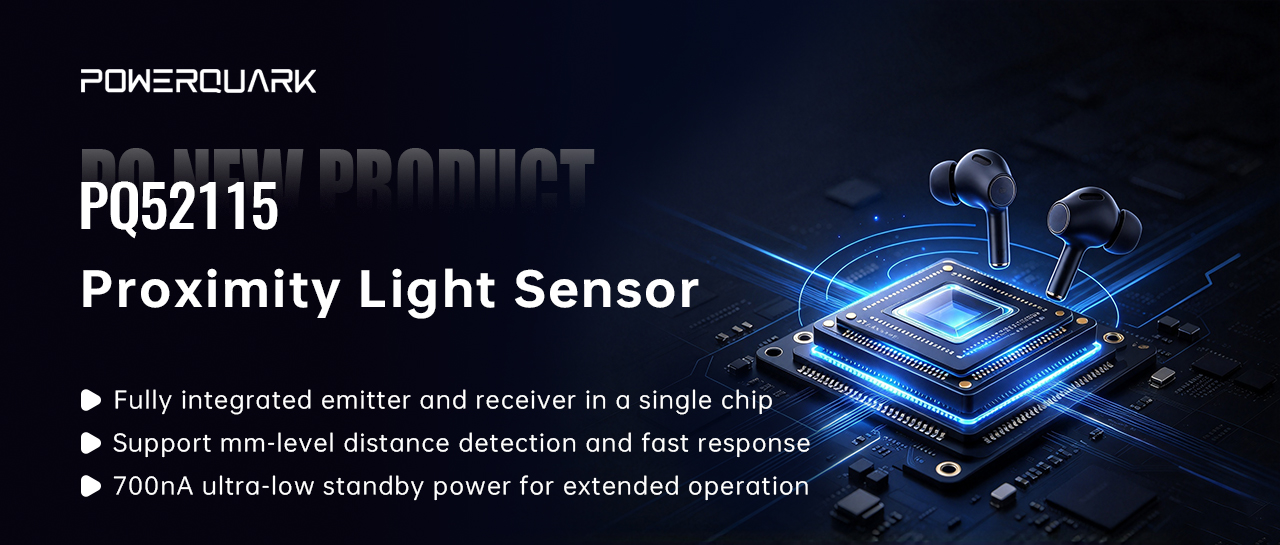
Today, Powerquark announced the launch of PQ52115, an integrated infrared proximity sensor. As Powerquark's first optical sensor, PQ52115 features a single-chip fully integrated transmitter and receiver in an ultra-compact package, supports millimeter-level distance detection, and delivers fast response. In addition, the chip achieves a standby current as low as 700nA, effectively extending the battery life of smart devices and making it an ideal fit for near-field optical switch applications in TWS earbuds, AR/VR glasses, and other wearables.
Optical Sensing Technology Drives an Upgrade in Consumer Electronics Experience
As consumer electronics continue to evolve toward greater intelligence and miniaturization, optical proximity sensors have become one of the core components for human-machine interaction and environmental perception. From wear detection in TWS earbuds to eye tracking in AR/VR glasses, optical sensing technology is redefining the smart experience of end devices. According to market research statistics, the global proximity sensor market reached USD 8.46 billion in 2025, up 12.3% YoY; the broader optical sensor market reached USD 26.6 billion in 2025 and is projected to grow to USD 71.7 billion by 2035, with a compound annual growth rate of 10.4%. In the smartphone segment, under-display proximity sensors have become standard in mid-to-high-end models, while wearables such as TWS earbuds are gradually emerging as a new growth driver for this market.
Product Advantages
Single-Chip Fully Integrated Solution: Manufactured using advanced CMOS process technology, PQ52115 integrates a VCSEL emitter, dual photodiodes, signal conditioning circuitry, and a high-precision ADC in an ultra-compact 2.0mmx1.0mmx0.5mm package. By combining transmission, reception, and signal processing into a single chip, it effectively reduces system board space and simplifies the optical design of end products. Meanwhile, targeted coating technology significantly enhances optical performance and interference resistance, ensuring stable output under complex lighting conditions.
Millimeter-Level Precision Detection: PQ52115 integrates a near-field and far-field dual photodiode architecture. Combined with programmable drive current and ADC resolution of up to 16 bits, it can precisely detect millimeter-level distance changes and respond quickly.
In addition, PQ52115 features ambient light cancellation, crosstalk cancellation, and wide-range offset adjustment, effectively suppressing optical interference from ambient light or within the device even in complex optical environments. PQ52115 also supports factory calibration and on-chip temperature compensation, ensuring stable detection accuracy across different temperatures and operating conditions.
Nanoampere-Level Standby Power Consumption: For power management, PQ52115 is deeply optimized for wearables with limited battery capacity. Its sleep current is as low as 700nA, and it supports an interrupt-driven operating mode that wakes the host only when detection results exceed preset thresholds, effectively reducing overall system power consumption and meeting the battery life requirements of long-term use.
From power management to optical sensing, Powerquark is extending its design capabilities accumulated in analog chips to a broader range of sensing and interaction scenarios, delivering near-field detection solutions that combine precision, power efficiency, and design flexibility to help customers achieve more responsive and reliable wear and interaction sensing.